


UNDERSTANDING DISC INJURIES
Why There is No Need to Panic
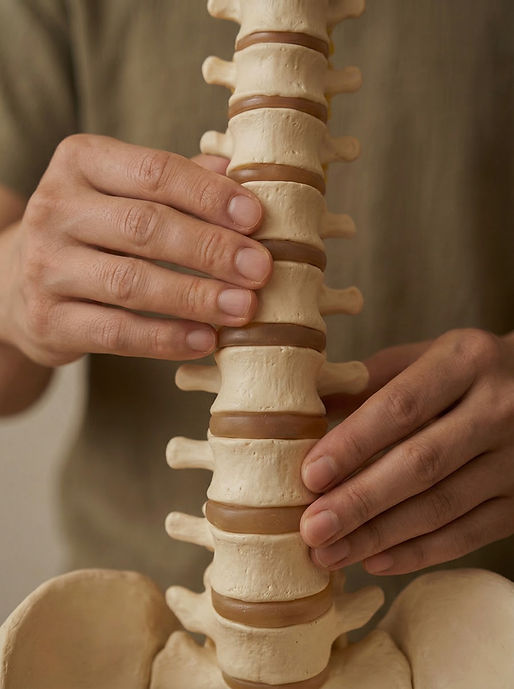
Your spine is made up of a series of bones (vertebrae) stacked on top of each other. Between each vertebra sits a spinal disc- a flexible structure that helps absorb load and allows your spine to move smoothly during everyday activities like bending, lifting, and twisting.
Each disc has two main parts:
-
A soft, gel-like centre which helps manage pressure.
-
A strong outer layer which contains and supports that centre.
When the spine is exposed to sustained posture, repetitive load, reduced movement, or injury, a disc can gradually change shape. This is what we call a disc bulge - when the gel-like centre presses outward against the outer layer, causing it to extend slightly beyond its usual boundary.
The reassuring truth: A bulging disc often develops gradually over time rather than suddenly. Most importantly, not all disc bulges cause pain. Many people have disc changes visible on scans whilst experiencing absolutely no symptoms or limitations.
ARE YOU EXPERIENCING ANY OF THESE SYMPTOMS?
When a disc injury does influence your body, symptoms can vary depending on the area involved. We regularly help patients in Chester find relief from:
-
Localised pain: Persistent stiffness, aching, or catching pain in your lower back or neck.
-
Nerve-related pain (Sciatica): Sharp pain, tingling, or "pins and needles" travelling into your shoulder, arm, buttock, or leg.
-
Restricted movement: A feeling of stiffness or reduced confidence during everyday activities.
-
Postural changes: Pain that worsens or shifts when sitting, bending, lifting, or standing upright


HOW WE ASSESS DISC PROBLEMS AT ALIGNED HEALTH
We believe good care starts with listening, clarity, and trust. We take the time to understand your symptoms, your health history, and how your pain behaves during your daily life.
Your comprehensive assessment at our Chester clinic includes:
-
A detailed discussion of your health and movement history.
-
Careful observation of your posture and active movement.
-
Range of motion, orthopaedic, and joint mobility testing.
-
A neurological assessment (checking your strength, reflexes, and sensation).
Do you need an MRI or Scan?
In the vast majority of cases, we can assess and begin treating disc-related problems clinically without any imaging. We only recommend X-rays or MRI scans if they are clinically necessary and will meaningfully inform your care plan.
ADVANCED, NON-SURGICAL DECOMPRESSION: IDD THERAPY
At Aligned Health, our approach is individualised. We focus on supporting your spinal movement, reducing unnecessary strain, and helping your body adapt and recover.Your tailored care plan may include gentle spinal techniques, soft-tissue work, rehab exercises, and ergonomic advice. However, if your assessment shows that disc changes are directly influencing your nerves, we may recommend IDD Therapy.
What is IDD Therapy?
Intervertebral Differential Dynamics (IDD) Therapy is a non-invasive, non-surgical spinal decompression treatment
How does it work?
It uses gentle, oscillating, and rhythmic decompression to target specific spinal segments, reducing pressure on irritated nerves and discs to promote natural healing.
Is it right for you?
IDD Therapy is used selectively where appropriate and is fully integrated alongside your hands-on chiropractic care.
